

Comedy of Errors

By William Shakespeare


SECTION LINKS
Land Acknowledgement
Creative Team
Cast
Running Crew
Preparatory Crew
Production Staff
How to Help Our Students


CREATIVE TEAM
Director...... Bibi Mama
Assistant Director...... *Cory Johnson       
Scenic Designer...... Mio Nuñez
Costume & Makeup Designer...... Kaylynn Sutton
Assistant Makeup Designer...... *Yvesie Rider
Lighting Designer...... *Lenore Booth       
Assistant Lighting Designer...... *Patrick Bator        
Audio Designers...... *Jonathan Demian & *Myles Hall  
Property Designer...... *Emmanuel Gonzalez
Assistant Property Designer......  *Haylee Rodriguez
* Current Students
Return to Top


We want to remind you that using any audio, video, or photographic recording devices is strictly prohibited.


CAST*
Antipholus of Syracuse......  Caitlyn Gong
Antipholus of Ephesus......  Faith Kim
Dromio of Syracuse......  Jackson Gonzales
Dromio of Ephesus......  Cassiel Reeves
Adriana......  Ella Bryant-Frey
Luciana......  Julianna Rossi
Duke Solinus & Dr. Pinch......  Mehrdad Modjtahedi
Egeon......  Jonathan Shimizu
Lady Abbess......  Axon Gonzales
Balthazar......  Connor Persson
Officer & First Merchant......  Nicolas Dunne
Second Merchant......  Chloe Conceicao
Jailer......  Mark Khella
Angela......  Lily Castañeda
Luce &Courtesan......  Stephanie Marin
Messenger & Attendant......  Charlotte Pulley
Ensemble......  Agripina Magallan

Understudies
(Understudies never substitute a listed performer unless an announcement is made prior the curtain)

Antipholus of Syracuse Understudy...... Connor Persson
Antipholus of Ephesus Understudy...... Charlotte Pulley
Dromio of Syracuse Understudy...... Chloe Conceicao
Dromio of Ephesus Understudy...... Axon Gonzales
Lady Abbess Understudy...... Stephanie Marin
Second Merchant Understudy...... Agripina Magallan
Angela Understudy...... Mark Khella
Courtesan Understudy...... Charlotte Pulley
Messenger Understudy...... Agripina Magalla
Return to Top

SPECIAL THANKS
Fullerton College Art Department- Stephen Klippenstein and Fullerton College Theater Operations


PRODUCTION STAFF
Dean of Fine Arts...... Dr. Grant Linsell
Theatre Arts Department Coordinator...... Zachary T. Harless
Office Manager...... Selene Parral
Office Assistant...... *Julie Allstun
Production Manager...... Zachary T. Harless
Lead Stage Manager...... *Cristobal Quezada
Stage Manager...... *Sarah Dobbins
Dramaturge...... *Cammie Kohlenberger
Scene Shop Supervisor...... Matthew Kenichi Muranaga
Charge Scenic Artist...... Mio Nuñez
Costume Shop Supervisor...... Vannessa Poveda
Lighting Supervisor...... Roxanne Rosas
Head Electrician...... Michele Jones
Assistant Head Electricians...... *Cristobal Quezada & *Laura Vega  
Property Design Advisor...... Zelida Solorio
Graphic Artist...... Juliana Vergas       
House Manager...... Cherie Mathews
* Current Students
Return to Top

RUN TIME
This performance runs approximately:
Act I: 50 minutes
Intermission: 15 minutes
Concessions will be served in the theatre’s forecourt. Please note that food and drink are not permitted inside the theater.
Act II: 52 minutes


DIRECTOR’S NOTE
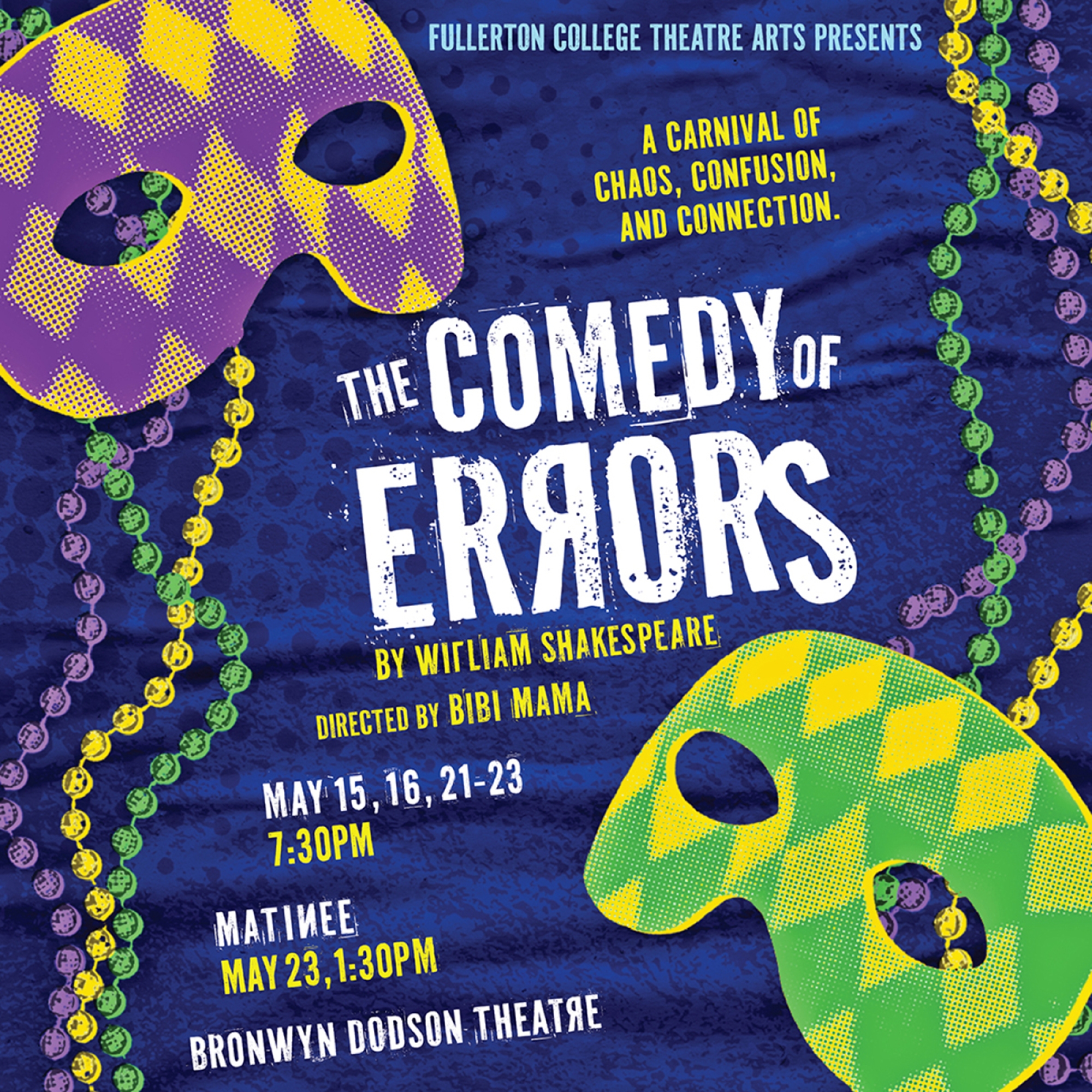
The Comedy of Errors is often referred to as one of Shakespeare’s silliest comedies. I mean, two sets of twins, constant mistaken identities, and a gold chain that somehow causes half the chaos of the play? The story already lives in a world of joyful absurdity. I wanted to push that energy even further by dropping us into the middle of one of the most vibrant celebrations in the world: Mardi Gras.

Mardi Gras, which literally means “Fat Tuesday,” is a Louisiana tradition rooted in celebration and abundance before the beginning of the 40-day Christian season of Lent. It is a world of masks, music, movement, and transformation, which made it the perfect setting for a play about identity and confusion. What fascinated me most about Mardi Gras as a setting is its relationship to identity. Carnival invites people to step outside of themselves through masks, costumes, music, and performance. In many ways, Shakespeare’s play does the same thing, placing its characters inside a world where appearances are unreliable and confusion opens the door to transformation.
 
But beneath the comedy, The Comedy of Errors is really a story about family and belonging. At the center of the play is a family separated by a shipwreck and torn apart by time, desperately trying to find their way back to one another. Our production begins not with celebration, but with loss that slowly transforms into music, joy, and reconnection. In that way, this production mirrors the emotional journey of the play itself: from grief to reunion, from confusion to recognition, and from isolation back into community.
 
Ultimately, this production asks us what it means to be seen clearly. In a city full of masks, mistaken identities, and constant performance, the characters are all searching for the same thing: connection. And maybe that’s why this centuries-old comedy continues to stand the test of time. Beneath all the madness, Shakespeare reminds us that even after chaos, separation, and loss, it is still possible to find your people—and your way home.
 
I would like to thank my colleagues for their unwavering support in this huge undertaking, the creative team for their talent and commitment, and the cast and crew for their energy, generosity, and willingness to throw themselves fully into the joyful chaos of this production.
 
Thank you for joining us, and please enjoy The Comedy of Errors
 
Director
Bibi Mama

Please be advised that the performers utilize the aisles of the theater for their entrances and exits. Please be aware of their presence.


RUNNING CREW*
 LEAD STAGE MANAGER
Cristobal Quezada
 
STAGE MANAGER
Sarah Dobbins
  
AUTOMATION OPERATORS
Giovanni Escarcega
Gizan Gando
 
GRIPS
Hayley Feria-Morales
David Mendoza
Aliecia Moreno
Tua Sue
 
HEAD OF WARDROBE
Ciel Codd
 
WARDROBE & MAKEUP CREW
Zachary Cuenco
Arlette Florencio
Chelsea Mallari
Sam Neal
Shiloh Striemer
 
LIGHTING CONSOLE OPERATORS
Jackson Clifford
Abel Ortiz
  
DECK ELECTRICIAN / A2
Aiden Oslick
 
AUDIO PLAYBACK OPERATOR 
Chace DaSilva
   
* Current Students
Return to Top

Please be advised that this production contains: theatrical haze, simulated drug and alcohol use, and prop weaponry.


 PREPARATORY CREW
LEAD CARPENTERS
Daniel A. Gutierrez
Martinez Martinez

CARPENTERS*
Patrick Bator
Lenore Booth
Jonathan Demian
John Gillispie
Tiberius Jaramillo
Efren Mendez
Leilani Narez

SCENIC PAINTERS*
Sara Duffy
Hayley Feria
Louisa Ortiz
Kim Yee

COSTUME CONSTRUCTION LEADS
Sarah Timm
Linda Rhodes
 
COSTUME CONSTRUCTION
Ciel Codd
Charlotte Eisenacher-Knott*
Max Feingold*
Arlette Florencio
Nataly Gutierrez*
Kathryn Jacobson*
Mckenzie Malone*
Jade Puskas*
 
ELECTRICIANS*
Patrick Baylor
Lenore Booth
Téa Bramham
Ceil Codd
Gizan Gando
Addison Gonzales
Jackson Gonzales
Myles Hall
Sydney Lopez
Martinez Martinez
Cynthia Montiel-Cruz
Aidan Oslick
Leilani Narez
Connor Persson
Sophia Philip
Cristobal Quezada
Haylee Rodriguez
Maryann Sandoval
Autumn Shade
Abigail Sissoyev
 Laura Vega
Anthony Villalobos
 
SOUND SYSTEM INSTALLERS*
Patrick Bator
Yessenia Beltran
Audrey D'Antonio
Jonathan Demian
Sarah Dobbins
Giovanni Escarcega
Gizan Gando
John Gillispie
Cindy Gonzalez
Sarah Hernandez
Japheth Lessin
Jonathan Martinez
Lucas Martins
Efren Mendez
Mehrdad Modjtahedi
Cynthia Montiel-Cruz
Leilani Narez
Abel Ortiz
Aiden Oslick
Sophia Philip
Haylee Rodriguez
Julianna Rossi
Malcolm Shirk
Anthony Villalobos
 
* Current Students

Our students need your help.
Please donate to our theatre scholarships today.
https://foundation.fullcoll.edu/donate/
Please add "Theatre Department" in the comments

Return to Top


DRAMATURGICAL NOTE
Our production of The Comedy of Errors centers on a series of misunderstandings caused by sets of identical twins, Antipholus and Dromio of Syracuse, as well as Antipholus and Dromio of Ephasus. Years after being separated at birth, they go outside their hometowns to find each other. However, their arrivals spark a number of incidents, including mistaken identity. This fast-paced, slapstick, feel-good comedy is set in Louisiana in the 1990s against the backdrop of Mardi Gras, where a joyful and musical carnival of mistaken identity comes to life. Full of jazz bands, high energy, feathers, sequins, beads, and lots of laughter, masks hide the true identity amongst the chaos. With mistaken identity being the central plotline of the show, the twins and countless others are incorrectly identified as someone else resulting in confusion, wrongful accusations, and comedic scenarios, all while using items like a gold chain or a key, which plays a role in the show’s themes and the plot’s chaotic nature.

Mardi Gras is a century-old pre-Lenten festival that is rooted in pagan, Christian, and West African, Voodoo-like spirits including Bacchus-Roman spirits. From Saturnalia/Lupercalia, Catholic saints, to Papa Legba and Gede, these spirits are interwoven into the culture of Louisiana bringing people together fostering a sense of diversity through shared celebration, parades, and food. Its colors are green, yellow, and purple. Green represents faith and the hope and vibrancy of the celebration. Yellow represents power and status, and purple represents justice symbolizing royalty and the history of Mardi Gras. During this 12-day period, there are countless parades that are organized by dozens of distinct private social clubs known as “Krewes,” each having their own themes and traditions to celebrate culture and offer service to the community. When beads and other essential items are thrown to the crowds, it is a way to spread cheer and encourage the crowd to participate in the parades, making it more immersive. Mardi Gras (now known as “Fat Tuesday”) represents a final day of indulgence, revelry, and feasting before the solemn Christian fasting season of Lent begins.
 
Masks are vital to Mardi Gras because they allow revelers to escape social, class, and gender identity, enabling the freedom to act without reputation damage, while also providing liberation for marginalized groups. People wear masks around each other to embrace anonymity, which allows them to escape social class and behave without consequence, while also removing them while they are alone. Masks give people during this time the freedom to move freely across social divides, acting as a “great equalizer” and allowing them to take on new personas without relieving their true selves. Feathers, beads, and sequins are also vital to Mardi Gras because they embody the spirit of excess, community interaction, and cultural tradition, which serves as the essential and vibrant material for the parades that are thrown during this time. Music is the vibrant backdrop of Mardi Gras with a blend of African, Caribbean, and European influences, acting as the “heartbeat,” signifying cultural identity, pride, and defiance against oppression through jazz, funk, brass, and celebratory chants. The environment of Mardi Gras acts as a reflection of the chaotic consumerist, and sometimes isolating nature of our modern world blending the themes of identity crisis, family and belonging, and self-discovery against the excess-driven backdrop of New Orleans.
 
Key songs that are mentioned in our production are “You Are My Sunshine” by Jimmie Davis and Charles Mitchell, as well as “Oh When The Saints Go Marchin’ In” by Louis Armstrong. You will also hear a lot of jazz musical transitions, which represent the chaos, fast-paced whimsical tone this show brings. The inclusivity of popular songs like “You Are My Sunshine” and “Oh When The Saints Go 
Marchin’ In” acts as a hallmark of modernized, musical adaptations, which are designed to enhance the story of the show and its whimsical tone, increasing accessibility and highlighting key themes of chaotic reunion. These songs rely on mistaken identity and absurdity, adding emotional and thematic flavor to the cultural environment of what Mardi Gras is, serving as a form of joyful resistance and storytelling fueling the energy of the music, street parades, and dancing.
 
This show offers a puzzling mirror to the current state of where our modern society is today. The environment deals with issues by mirroring our chaotic, absurd, and transactional nature, while providing a cathartic outlet for collective anxiety in this time and age. Mardi Gras also acts as a mechanism for rebuilding community and channeling grief while environmental impact mirrors the global crisis navigating a society post-pandemic through enforced separation, mistaken identity, and the struggle to regain order in a broken world. There is a continued influence by establishing the foundational blueprint for mistaken identity trope in media, while offering relevant insights into the chaotic nature of our world today, mirroring the themes of the show regarding technology, social labeling, and the fragmented, fast-paced living lifestyles.
 
The Comedy of Errors isn’t just about mistaken identity, this show is a reminder of the fragile nature of identity and the existential terror of not being recognized, as well as the need for human belonging. Identity is not solely innate, it is relational as we often know who we are based on how others perceive us. Are you desperate for others to perceive you the right way, or are you often misread based on the “digital” identity you present?
Return to Top

Fullerton College is located on the unceded ancestral lands shared by the Gabrielino-Tongva Nation and the Juaneño Band of Mission Indians/Acjachemen Nation, who have been the traditional caretakers since time immemorial. Tongva and Acjachemen peoples maintain a strong presence in North Orange County and throughout Southern California, protecting their homelands, knowledge systems, and cultures for the next seven generations. We acknowledge the ingenuity, survival, resilience, and strength of their descendants and relatives–past, present, and emerging. We also acknowledge the labor of those who work on and care for these lands, both in the past and today, and all those who act in solidarity with Indigenous struggles.

Our Ethnic Studies Department has created a list of action items, groups, and organizations to support, as well as educational resources found at:
https://socsci.fullcoll.edu/ethnic-studies/acknowledgement/
Return to Top